


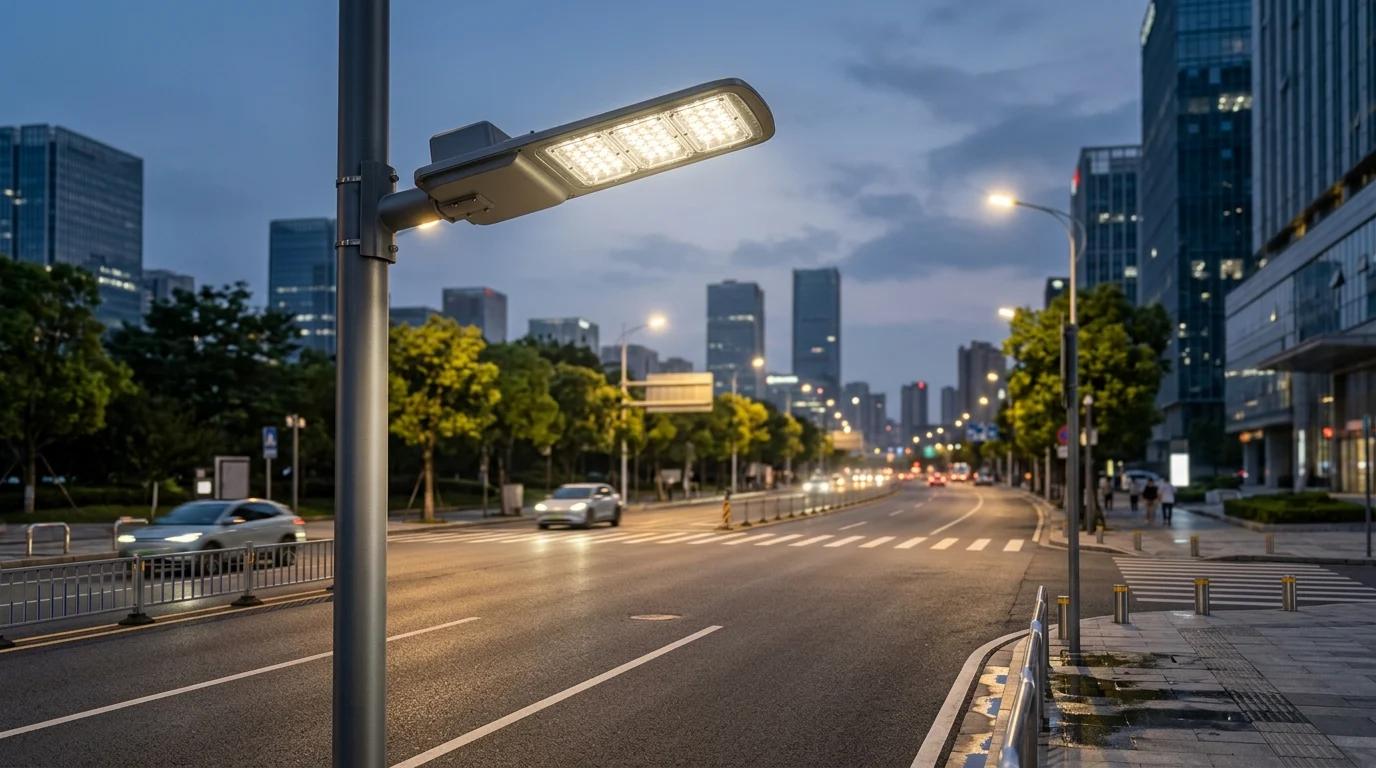
Street lighting is no longer just a utility expense—it is becoming a connected infrastructure asset. As cities prepare for tighter efficiency expectations, grid pressure, and smarter maintenance models, 2026-ready Led Street Lightsare being evaluated for more than brightness alone. The latest systems combine high-efficacy LED chips, improved thermal engineering, Zhaga and DALI-2 control interfaces, dynamic dimming, and predictive monitoring to reduce total cost of ownership. For municipalities, developers, and procurement teams, the challenge is choosing fixtures that meet today’s budget limits while remaining adaptable for tomorrow’s smart-city requirements. This update explains the technologies, performance benchmarks, and specification choices shaping modern Led Street Lighting.
Latest LED Street Lighting Innovations for 2026
As urban infrastructure evolves toward the 2026 horizon, upgrading street lighting networks requires looking beyond basic illumination to address impending efficiency mandates and region-specific regulatory shifts. Modern LED street lights—such as those engineered by Ningbo Leboda Lighting, which utilize rigorous factory-level quality protocols and proprietary thermal designs—now serve as the digital backbone of smart cities. Specifying fixtures today means deploying intelligent nodes capable of drastically reducing energy consumption while supporting advanced IoT sensors.
With system efficacies now routinely exceeding 170 lumens per watt (lm/W)—a significant jump from the 130 lm/W baseline just a few years ago—the operational savings justify accelerated replacement cycles. In many municipal applications, upgrading legacy high-pressure sodium (HPS) systems to 2026-standard LEDs yields a return on investment in under three years. However, initial fixture costs still exceed legacy HPS. To overcome these upfront capital expenditure (capex) barriers, municipalities increasingly rely on financing mechanisms such as energy-service performance contracts (ESPCs) or municipal leasing, making accelerated replacement cycles financially feasible. Actual ROI ultimately depends on local electricity rates, climate, and the existing HPS baseline wattage.
Key Technologies to Define First
Navigating these innovations requires defining the core technologies driving performance. High-density Surface Mounted Device (SMD) 5050 and 3030 LED chips have become the industry standard, offering superior thermal dissipation and luminous flux. Effective thermal management remains the primary bottleneck for LED longevity. By utilizing multi-fin heat sinks and phase-change materials, modern fixtures are designed to maintain junction temperatures below 75°C in documented deployments, even in harsh ambient environments.
There is also a universal shift toward standardized driver interfaces. Zhaga Book 18 sockets paired with DALI-2 (Digital Addressable Lighting Interface) protocols are now essential for future-proofing installations and avoiding vendor lock-in. However, control selection in 2026 is often constrained by existing pole wiring and budget cycles. While Zhaga interfaces enable plug-and-play communication nodes without opening the luminaire housing—ensuring IP66 waterproof ratings remain intact—legacy NEMA interfaces may still be required where upfront retrofit costs or compatibility with existing infrastructure present barriers.
Where 2026 Updates Create Strategic Value
The strategic value of 2026 updates lies in total cost of ownership (TCO) reduction and grid resilience. By integrating constant lumen output (CLO) programming, drivers can automatically compensate for diode depreciation over time, maintaining a flat energy draw and extending the L90 lifespan up to 100,000 hours under ideal conditions.
Furthermore, these upgrades allow municipalities to reduce peak load demands by an estimated 20% to 40% (heavily dependent on local grid conditions, baseline usage, and dimming profiles) through dynamic dimming schedules, freeing up critical grid capacity for other emerging technologies like EV charging networks. Rather than waiting for citizen complaints, centralized management software flags voltage anomalies and diode failures in real-time. In specific municipal case studies, this predictive maintenance model has been shown to reduce truck roll costs by up to 50% over the fixture's operational life compared to reactive maintenance baselines.
Additionally, 2026 procurement criteria increasingly weigh sustainability alongside performance. Features like the modular replaceability of drivers and sensors, combined with the recyclability of aluminum housings, support circular-economy goals and reduce end-of-life environmental impacts.
Comparing 2026 LED Street Lighting Controls and Optics

Optimizing a street lighting network requires a careful balance between responsive controls and precision optics. The 2026 landscape favors abandoning static lighting for adaptive systems that direct light exactly where and when it is needed.
| Category | Technology Standard | Primary Use Case | Key Characteristics |
|---|---|---|---|
| Physical Interface | Traditional NEMA (3- to 7-pin) | Legacy smart nodes, basic photocells | Line voltage (120-277V), top-mounted |
| Physical Interface | Zhaga Book 18 (4-pin) | Low-voltage IoT sensors, DALI-2 nodes | 24V DC, IP66 sealed, compact |
| Comm. Protocol | LoRaWAN / NB-IoT | Centralized CMS, remote monitoring | Wireless RF/Cellular, encrypted |
| Internal Wiring | DALI-2 / 0-10V | Driver-to-node communication | Standardized digital/analog dimming |
Photocells, Timers, Sensors, and Smart Controls
When evaluating controls, the transition from traditional NEMA 7-pin receptacles to Zhaga Book 18 sockets represents a major paradigm shift. For simple dusk-to-dawn operation, standard photocells remain cost-effective. However, 2026 standards favor smart controls operating on LoRaWAN or NB-IoT networks. Municipal readers must navigate real-world barriers such as LoRaWAN vs. NB-IoT coverage gaps and vendor lock-in risks. As municipal RFPs increasingly require network-hardening, it is critical to specify systems with robust cybersecurity measures—such as AES-128 encryption and DTLS (Datagram Transport Layer Security)—to protect smart-city infrastructure.
These systems enable adaptive dimming based on real-time traffic data collected by integrated microwave or radar sensors. Deploying these smart controls can reduce energy waste during off-peak hours (e.g., midnight to 5:00 AM) by dropping illumination levels to 20-30% of maximum output, instantly ramping back to 100% when vehicular or pedestrian movement is detected. Unlike infrared sensors, microwave modules can penetrate the luminaire housing, keeping the IP66 seal intact while providing reliable detection regardless of ambient temperature.
Roadway Optics, Glare Control, and Color Quality
On the optical front, preventing light pollution and minimizing glare are critical priorities. Selecting fixtures with precise secondary polycarbonate or PMMA lenses that deliver Type II, Type III, or Type IV light distributions tailored to specific lane widths and pole heights is essential. To meet rigorous Dark Sky compliance, ensure chosen luminaires boast a <1% Upward Light Ratio (ULR).
Color quality also plays a vital role in roadway safety. While 5000K was once popular for its high perceived brightness, warmer Correlated Color Temperatures (CCT) between 2700K and 3000K are gaining traction for dark-sky and health reasons, although 3000K–4000K remains widely specified in many municipal standards. It is important to note the luminous efficacy trade-off: warmer CCTs typically deliver fewer lumens per watt than 4000K–5000K alternatives, which must be factored into driver sizing and pole-spacing calculations. This shift minimizes blue light scattering, reduces driver fatigue, and maintains a Color Rendering Index (CRI) of at least 70, ensuring accurate color recognition of road signs and pedestrians.
Specifying and Sourcing 2026-Ready LED Street Lighting
As municipalities and contractors upgrade urban infrastructure, leveraging "The Latest Innovations in Led Street Lighting (2026 Update)"--Ningbo Leboda Lighting requires a strategic approach to procurement. You must align photometric performance with specific environmental demands while ensuring future-proof compatibility.
Specification Steps by Road Class and Use Case
Navigating urban lighting requirements means matching fixture specifications to strict road classifications. Follow these steps to ensure compliance and optimal visibility:
- Identify the Lighting Class: Determine if your project falls under motorized traffic (e.g., M-class in European standards) or pedestrian and low-speed areas (P-class). M-class roads demand high luminance and strict glare control (low Threshold Increment), while P-class areas prioritize horizontal illuminance and facial recognition (color rendering index >70).
- Select the Right Optics: Specify light distribution patterns based on lane width and pole spacing. Type II and Type III distributions are standard for multi-lane highways, whereas Type V suits wide intersections.
- Integrate Future-Ready Nodes: Mandate standardized Zhaga Book 18 or 7-pin NEMA receptacles. This ensures your infrastructure is ready for plug-and-play IoT sensors and DALI-2 adaptive dimming controllers.
Procurement Criteria for Long-Term Performance
When sourcing fixtures, focusing purely on initial wattage or lumen output is no longer sufficient. To guarantee a 100,000-hour lifespan (L90B10), evaluate the following criteria:
- Thermal Management: Look for heavy-duty die-cast aluminum housings with optimized heat sinks. Effective thermal dissipation prevents early LED lumen depreciation and driver failure.
- Driver Reliability: Specify programmable LED drivers with a minimum of 10kV/10kA surge protection to withstand grid fluctuations and lightning strikes.
- International Certifications: Ensure fixtures carry verifiable ENEC, CB, and CE certifications, confirming safety and environmental compliance for global markets.
| Procurement Metric | Legacy Standard | 2026-Ready Benchmark |
|---|---|---|
| System Efficacy | 120–130 lm/W | >150 lm/W |
| Surge Protection | 4kV–6kV | 10kV–20kV |
| Control Interface | Hardwired 1-10V | Zhaga Book 18 / DALI-2 |
| Lifespan Standard | L70 at 50,000 hrs | L90 at 100,000 hrs |
By rigorously applying these specification and procurement standards, you ensure that your investments in urban lighting are resilient, energy-efficient, and prepared for the smart-city networks of the coming decade.
Key Takeaways
- Specify Led Street Lights with efficacy above 170 lm/W when energy savings and faster HPS replacement payback are priority goals.
- Use Zhaga Book 18 and DALI-2 interfaces where possible to simplify future control upgrades and reduce vendor lock-in.
- Evaluate ROI using local electricity rates, existing HPS wattage, climate conditions, financing structure, and planned dimming profiles.
- Prioritize thermal management features such as multi-fin heat sinks to protect LED junction temperatures and extend fixture life.
- Apply CLO programming and dynamic dimming to stabilize lumen output, reduce peak load, and improve total cost of ownership.
- Include centralized monitoring in procurement plans to detect failures early and reduce reactive maintenance truck rolls.
Frequently Asked Questions
What LED street light efficacy should municipalities expect in 2026?
Many modern Led Street Lights now exceed 170 lm/W, compared with older 130 lm/W benchmarks. Higher efficacy can reduce energy use and improve project payback, especially when replacing high-pressure sodium systems.
Why are Zhaga Book 18 and DALI-2 important for street lighting?
Zhaga Book 18 sockets and DALI-2 protocols support plug-and-play controls, easier upgrades, and reduced vendor lock-in. They also allow communication nodes to be installed without opening the luminaire housing.
How fast can LED street lighting upgrades pay back?
In many municipal HPS-to-LED replacement projects, payback can be under three years. Actual ROI depends on electricity prices, fixture wattage, climate, dimming strategy, financing, and maintenance savings.
What role does thermal management play in LED street light lifespan?
Thermal design is critical because excessive junction temperature shortens LED life. Multi-fin heat sinks and advanced materials help maintain stable temperatures and support long service life in harsh outdoor conditions.
How do smart controls reduce street lighting operating costs?
Smart controls enable dynamic dimming, fault alerts, voltage monitoring, and predictive maintenance. These features can reduce peak load, cut unnecessary energy use, and lower truck roll costs.
